If you’re considering a heat pump for your home, you’ll probably come across two similar terms: air-to-air and air-to-water heat pumps.
Both take heat from the outside air and use electricity to transfer that heat into your home. The main difference is how they deliver the heat inside the property.
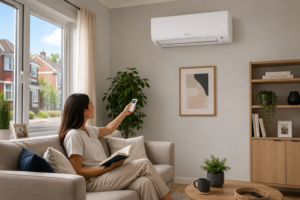
An air-to-air heat pump heats the air inside your rooms using indoor units. It can also usually provide air conditioning during warmer weather.
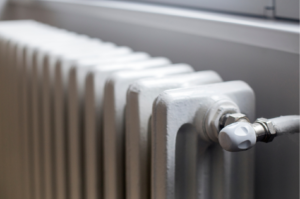
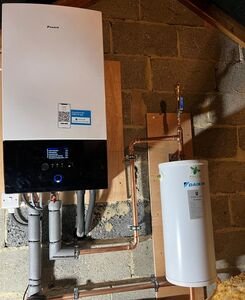
An air-to-water heat pump heats water that circulates through radiators or underfloor heating and can normally provide domestic hot water as well.
Neither system is automatically better. The right choice depends on your property, existing heating system, hot water requirements and whether you want cooling as well as heating.
At 2 Brothers Renewables Ltd, we provide renewable heating solutions across Dorset and the South Coast. In this guide, we’ll explain the air-to-air vs air-to-water heat pump difference and help you understand which system could be more suitable for your home.
Air-to-Air vs Air-to-Water Heat Pumps: The Simple Difference
The easiest way to understand the difference is to look at where the heat goes.
Air-to-air: takes heat from outside and delivers warm air directly into your rooms.
Air-to-water: takes heat from outside and transfers it into water for your central heating system.
| Air-to-Air Heat Pump | Air-to-Water Heat Pump |
|---|---|
| Heats rooms using warm air | Heats water for radiators or underfloor heating |
| Usually provides cooling as well | Primarily designed for water-based heating |
| Usually doesn’t provide domestic hot water | Can provide domestic hot water |
| Doesn’t require radiators | Works with radiators or underfloor heating |
| Useful for individual rooms or zones | Often used as a whole-home heating system |
| £2,500 Boiler Upgrade Scheme grant available for qualifying installations | £7,500 Boiler Upgrade Scheme grant available for qualifying installations |
That is the fundamental difference between air-to-air and air-to-water heat pumps. The rest of the decision comes down to how you want to heat your home.
What Is an Air-to-Air Heat Pump?
An air-to-air heat pump takes heat from the outside air and transfers it directly into the air inside your home.
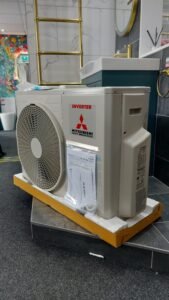
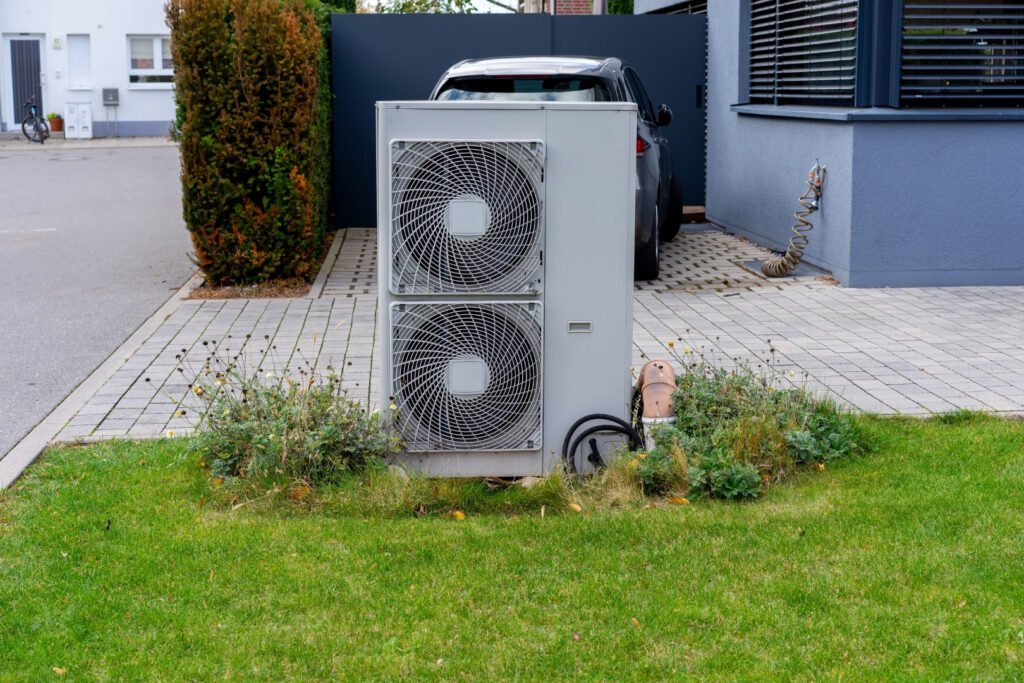
The system normally consists of an outdoor unit connected to one or more indoor units.
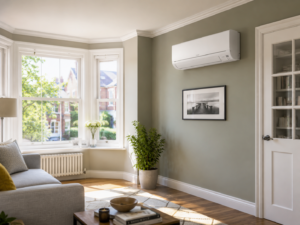
Instead of heating radiators, the indoor units distribute warm air around the room.
During warmer weather, many systems can reverse the process and transfer heat from inside your home to outside. In other words, the same air-to-air heat pump can provide heating and cooling.
This is why air-to-air heat pumps are also commonly associated with modern air conditioning systems.
According to the Energy Saving Trust, air-to-air heat pumps can be particularly suitable for smaller homes and flats, although they can also be used across multiple rooms with an appropriately designed system.
What Is an Air-to-Water Heat Pump?
An air-to-water heat pump also extracts heat from the outside air, but instead of blowing warm air directly into your rooms, it transfers that heat into water.
The heated water can then circulate through:
- Radiators
- Underfloor heating
- Low-temperature heating systems
An air-to-water system can also normally heat water stored in a cylinder for showers, baths and taps.
This makes an air-to-water heat pump more similar to a traditional boiler from the homeowner’s perspective. You still have a wet central heating system, but the heat is being produced differently.
The government’s Energy Technology List defines air-to-water heat pumps as systems that transfer heat from the outside air into a water-based heating system.
Which Heat Pump Is Better for Whole-House Heating?
For homeowners who already have radiators or underfloor heating and want to replace a traditional boiler, an air-to-water heat pump will often be the more familiar solution.
It can supply heating throughout the property using the existing type of wet central heating system.
However, that doesn’t mean every existing radiator will automatically be suitable.
Heat pumps generally work most efficiently at lower water temperatures than traditional boilers, so some radiators may need to be upgraded.
You can read our guide on heat pump radiators to understand when existing radiators can stay and when larger radiators may be required.
An air-to-air heating system takes a different approach. Instead of circulating hot water around the house, indoor units provide warm air directly to individual rooms or zones.
That can work particularly well where a wet central heating system isn’t required or where individual room control is important.
Which Heat Pump Can Provide Air Conditioning?
This is one of the biggest advantages of an air-to-air heat pump.
Most reversible air-to-air systems can provide both heating and cooling.
During winter, the system takes heat from outside and brings it into your home. During summer, it reverses the process and removes heat from inside.
You therefore get heating and air conditioning from the same system.
The UK government’s 2026 research into reversible air-to-air heat pumps specifically assessed their ability to provide both heating and cooling in different types of UK homes.
You can read the research on GOV.UK.
Some air-to-water heat pumps can technically provide cooling through compatible systems, but this isn’t normally their main attraction in a typical UK residential installation.
If summer cooling is a major priority, air-to-air vs air-to-water heat pumps becomes an important comparison.
Which Heat Pump Provides Hot Water?
For most homes, this is where air-to-water heat pumps have a clear advantage.
An air-to-water system can normally heat a domestic hot water cylinder as well as providing space heating.
This means one heat pump can provide:
- Central heating
- Hot water for showers
- Hot water for baths
- Hot water for taps
A typical air-to-air heat pump doesn’t provide domestic hot water.
You would therefore need another way to heat water, such as an electric hot water cylinder or another compatible system.
There are some specialised systems that combine air-to-air heating with domestic hot water production, but these aren’t representative of most standard residential air-to-air installations.
Do Air-to-Air Heat Pumps Need Radiators?
No.
An air-to-air heat pump doesn’t use radiators because it heats the air inside the room directly.
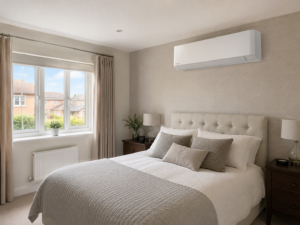
Indoor units are normally mounted on walls, although other indoor-unit designs are available.
This can make an air-to-air heating system particularly interesting for properties that don’t already have wet central heating.
It can also avoid some of the radiator upgrades that may be required when converting an older boiler-based heating system to an air-to-water heat pump.
Do Air-to-Water Heat Pumps Need New Radiators?
Not always.
An air-to-water heat pump with radiators can sometimes use the radiators already installed in the property.
However, because heat pumps generally operate most efficiently at lower water temperatures, some existing radiators may not provide enough heat.
In that situation, individual radiators can be upgraded to larger or higher-output models.
This doesn’t necessarily mean replacing every radiator in the house.
A room-by-room heat loss assessment should determine which radiators are suitable and which need changing.
Which Is Better with Underfloor Heating?
Air-to-water heat pumps work particularly well with underfloor heating.
Underfloor heating uses a large surface area to distribute warmth, which means it can operate effectively with relatively low water temperatures.
That matches the way air-to-water heat pumps operate efficiently.
You don’t need underfloor heating to install an air-to-water heat pump, though. Properly sized radiators can also work effectively.
An air-to-air system doesn’t require underfloor heating because it delivers warm air directly into the room.
Which Is Better for Individual Room Control?
An air-to-air heat pump can be particularly useful when you want independent control over different rooms.
For example, a multi-split system can have indoor units in several rooms connected to an outdoor unit.
You can then control the temperature of individual areas rather than heating the entire property to exactly the same level.
This can be useful for:
- Bedrooms
- Home offices
- Living rooms
- Garden rooms
- Flats
- Extensions
An air-to-water system can also provide zoned heating when designed appropriately, but it works through the property’s water-based heating system rather than individual warm-air units.
Which Is More Efficient: Air-to-Air or Air-to-Water?
Both types of heat pump can be highly efficient when they’re correctly designed and used in suitable properties.
There isn’t a useful universal answer that says one technology will always be more efficient than the other.
The actual efficiency depends on the system, outdoor temperature, required indoor temperature and how much of a temperature increase the heat pump needs to provide.
For an air-to-water heat pump, the required water flow temperature is particularly important. Lower heating-water temperatures generally allow the heat pump to operate more efficiently.
For an air-to-air heat pump, system design, indoor-unit positioning and the temperatures you’re trying to maintain also affect performance.
The better comparison is therefore not simply which technology has the highest efficiency figure, but which system is better suited to your property.
How Much Does an Air-to-Air Heat Pump Cost?
Air-to-air systems can be relatively affordable compared with a complete air-to-water central heating installation, particularly when only one or two rooms require heating and cooling.
Energy Saving Trust currently estimates approximately £1,900 for a one-room air-to-air heat pump installation and around £3,700 for a three-bedroom semi-detached home.
These are broad estimates rather than quotations, and the actual air-to-air heat pump cost depends on the number of indoor units, system selected and complexity of the installation.
You can see the latest estimates on the Energy Saving Trust website.
How Much Does an Air-to-Water Heat Pump Cost?
An air-to-water heat pump cost is normally higher because you’re installing a complete central heating system rather than simply heating individual rooms.
The project may include:
- The outdoor heat pump
- Hot water cylinder
- Heating controls
- Radiator upgrades
- Pipework changes
- Electrical work
- System design and commissioning
The exact cost therefore depends heavily on the property and existing heating system.
However, government grants can substantially reduce the amount an eligible homeowner needs to pay.
Can You Get a Grant for Air-to-Air and Air-to-Water Heat Pumps?
Yes. As of 2026, qualifying installations can receive support through the Boiler Upgrade Scheme in England and Wales.
The current grants are:
- £2,500 towards an air-to-air heat pump
- £7,500 towards an air-to-water heat pump
There is also temporary additional support for certain off-gas-grid properties replacing oil or LPG heating.
The eligibility rules and grant values can change, so homeowners should always check the latest information before making a decision.
You can check the current Boiler Upgrade Scheme grants on GOV.UK.
Air-to-Air vs Air-to-Water Heat Pump Running Costs
The air-to-air vs air-to-water heat pump running cost comparison depends heavily on how each system is being used.
An air-to-air system heating one or two occupied rooms isn’t directly comparable with an air-to-water system providing central heating and domestic hot water for an entire house.
Running costs depend on:
- Property heat loss
- System efficiency
- Electricity tariff
- Number of rooms being heated
- Temperature settings
- Hot water requirements
- How the heating system has been designed
Rather than choosing solely on an advertised efficiency figure, the system should be assessed against what you actually need it to do.
Which Is Better for a Flat or Small Home?
An air-to-air heat pump can be particularly attractive for smaller homes and flats.
It doesn’t require radiators or a complete wet central heating system, and it can provide both heating and cooling.
Energy Saving Trust specifically identifies smaller homes and flats as properties where air-to-air heat pumps can be a good option.
The lack of integrated domestic hot water does need to be considered, however.
If you want one system to provide central heating and hot water throughout the property, an air-to-water system may still make more sense.
Which Is Better for a Larger Family Home?
For a larger home with an existing radiator system and significant hot water requirements, an air-to-water heat pump will often provide the more complete replacement for a traditional boiler.
It can supply heating throughout the house and heat a domestic hot water cylinder.
However, an air-to-air system shouldn’t automatically be ruled out.
Properties with particular heating and cooling requirements may benefit from an air-to-air or multi-split system, particularly where individual room control is important.
The property needs to be assessed as a whole rather than choosing a heat pump purely because of its name.
Air-to-Air vs Air-to-Water Heat Pumps: Which Is Better?
An air-to-air heat pump may be better if:
- You want both heating and cooling
- You don’t need the heat pump to provide domestic hot water
- You want independent control over individual rooms
- Your property doesn’t already have a wet central heating system
- You’re heating a smaller home, flat or specific areas
An air-to-water heat pump may be better if:
- You want to replace a gas or oil boiler
- You already have radiators or underfloor heating
- You want one system for central heating and domestic hot water
- You’re looking for a whole-house heating solution
- Your property is suitable for a hot water cylinder
Neither list should be treated as an absolute rule.
The right air-to-air vs air-to-water heat pump choice depends on the property and what you actually expect the heating system to provide.
Air-to-Air and Air-to-Water Heat Pumps in Dorset
Properties across Dorset range from flats and modern developments to cottages, detached family homes and rural properties without mains gas.
That makes both air-to-air and air-to-water heat pumps relevant depending on the property.
A small flat requiring independent heating and summer cooling may have very different requirements from a detached family home replacing an oil or gas boiler.
Before choosing between the two, it’s worth considering the existing heating system, heat loss, hot water demand, available space and whether cooling is important to you.
Heat Pumps from 2 Brothers Renewables Ltd
At 2 Brothers Renewables Ltd, we provide renewable heating solutions across Dorset and the South Coast.
Choosing between air-to-air vs air-to-water heat pumps should start with understanding the property rather than simply choosing whichever technology sounds more efficient.
We consider the heating requirements, existing system, hot water demand, available indoor and outdoor space and how you actually use the property.
This makes it possible to determine which type of heat pump is appropriate and what additional changes may be required.
So, What’s the Difference Between Air-to-Air and Air-to-Water Heat Pumps?
The main difference is simple.
Air-to-air heat pumps heat the air inside your rooms and can usually provide cooling as well.
Air-to-water heat pumps heat water for radiators, underfloor heating and domestic hot water.
If you’re looking for heating and cooling with individual room control, air-to-air may be particularly attractive.
If you’re looking to replace a traditional boiler with a system that can provide whole-home heating and hot water, air-to-water may be the more natural choice.
If you’re unsure which is right for your property, contact 2 Brothers Renewables Ltd to discuss your home and the most suitable heat pump options.