
If you’re thinking about installing air conditioning at home, you may be wondering whether you need planning permission before the work can go ahead.
For many homeowners in England, planning permission may not be required for a modern air conditioning system that provides both heating and cooling, provided the installation meets the conditions for permitted development.
However, there are important exceptions. Planning permission may be required depending on the type of system, where the outdoor unit will be installed, the type of property and whether the building is listed or located within a protected area.
At 2Brothers Cooling Ltd, we provide professional air conditioning services across Dorset and the South Coast. In this guide, we’ll explain the main planning rules homeowners should be aware of before installing air conditioning.
Does Air Conditioning Need Planning Permission in England?
Not always.
Under current planning rules in England, certain air conditioning systems can fall under permitted development rights. This means the necessary planning permission is already granted nationally, provided the installation meets all of the relevant limits and conditions.
This is particularly relevant to modern air-to-air heat pump systems that can provide both cooling and heating.
The rules changed in 2025 to make it easier for more homeowners to install air source heat pumps without submitting a full planning application. These changes also allowed qualifying air source heat pumps capable of both heating and cooling to benefit from permitted development rights.
You can check the current rules on the Planning Portal.
What Is Permitted Development?
Permitted development allows certain types of work to be carried out without submitting a normal planning application.
It doesn’t mean that there are no rules.
The installation still needs to meet the conditions and limitations set out in planning legislation. If your proposed air conditioning installation falls outside those limits, you may need to apply for planning permission.
Permitted development rights can also be restricted or removed for individual properties or areas, so it’s important not to assume that every home automatically qualifies.
What Changed for Air Conditioning and Heat Pumps?
This is where older information online can become confusing.
Historically, the permitted development rules for domestic air source heat pumps were more restrictive.
Changes introduced in England in May 2025 made several important adjustments, including:
- Allowing qualifying air source heat pumps to be installed closer than one metre to a property boundary
- Increasing the maximum outdoor unit volume for houses from 0.6m³ to 1.5m³
- Allowing up to two air source heat pumps under permitted development at detached houses
- Allowing qualifying systems that provide both heating and cooling to benefit from permitted development rights
This last change is particularly relevant to modern home air conditioning.
Many fixed split air conditioning systems are technically air-to-air heat pumps. They can cool your home during summer and reverse their operation to provide heating during colder weather.
The government has confirmed that the changes allow qualifying air-to-air heat pumps providing heating and cooling to benefit from permitted development rights.
You can read about these changes in the government’s Warm Homes Plan.
What If Your Air Conditioning Only Provides Cooling?
This is an important distinction.
The Planning Portal states that the permitted development rights for domestic air source heat pumps do not apply where the system is used solely for cooling.
If you’re installing a cooling-only air conditioning system, you should therefore expect that a planning application may be required.
Fortunately, many modern residential split systems can provide both heating and cooling, but the exact equipment and proposed installation still need to meet the other permitted development requirements.
Don’t assume that simply calling a system an “air conditioner” or a “heat pump” determines its planning status. What the equipment does and how it is installed are what matter.
What Are the Main Permitted Development Rules?
For a domestic air source heat pump installation in England to qualify as permitted development, several conditions need to be met.
Some of the main requirements include:
- The installation must comply with the applicable MCS Planning Standards
- The outdoor compressor unit must stay within the permitted size limits
- The installation must comply with rules covering the number of outdoor units permitted
- The unit cannot be installed on a pitched roof under these permitted development rights
- If installed on a flat roof, it must meet the required distance from the roof edge
- Additional restrictions apply to listed buildings, scheduled monuments, conservation areas and World Heritage Sites
- The equipment should be positioned, as far as practical, to minimise its effect on the appearance of the property and the surrounding area
There are additional conditions, so homeowners should not use this list as a substitute for checking their individual property.
The full domestic guidance is available from the Planning Portal.
How Big Can the Outdoor Air Conditioning Unit Be?
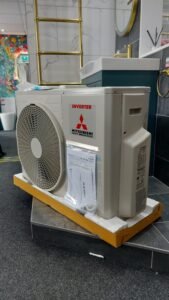
For a house in England, the current permitted development rules allow an outdoor compressor unit with a volume of up to 1.5 cubic metres, including its housing.
For a block of flats, the permitted volume is smaller at 0.6 cubic metres.
Most domestic wall-mounted split systems use outdoor units that are considerably more compact than large commercial equipment, but the actual model still needs to be checked as part of the proposed installation.
Does the Outdoor Unit Need to Be One Metre from the Boundary?
Not under the current English rules simply because it is an air source heat pump.
This is another area where you may find outdated advice online.
Previously, permitted development rules required the outdoor unit to be at least one metre from the property boundary.
That restriction was removed in England in 2025, making installations easier for properties with smaller gardens or limited outdoor space.
However, this does not mean an outdoor unit should simply be installed as close to a neighbour as possible.
Noise, airflow, accessibility, appearance and the effect on neighbouring properties still need to be considered when choosing the position.
What About Noise from the Outdoor Unit?
Noise is an important part of planning a residential air conditioning installation, particularly where properties are close together.
The permitted development rules require qualifying installations to comply with the relevant MCS Planning Standards.
The location of the outdoor unit can therefore be important.
A professional installer should consider:
- Distance from neighbouring properties
- Nearby bedroom windows
- Walls that could reflect sound
- Outdoor unit sound levels
- Mounting method
- Airflow around the equipment
Even where planning permission isn’t required, careful positioning helps reduce the risk of unnecessary disturbance to neighbours.
Can You Put an Air Conditioning Unit on the Front of Your House?
Sometimes, but there are restrictions depending on the property and the position of the equipment.
For properties outside conservation areas and World Heritage Sites, permitted development rights restrict installations above ground-floor level on a wall that fronts a highway.
Additional restrictions apply within conservation areas and World Heritage Sites.
For that reason, the side or rear of the property is often a more straightforward location for an outdoor unit, provided it is technically suitable.
Appearance isn’t the only consideration. Pipework length, drainage, access, noise and airflow also need to be taken into account.
Can You Put an Air Conditioning Unit on a Roof?
The permitted development rules do not allow an air source heat pump to be installed on a pitched roof.
Installation on a flat roof may qualify, but the equipment must meet the applicable conditions, including positioning at least one metre from the external edge of the roof.
If the proposed installation doesn’t meet those conditions, a planning application may be required.
Do You Need Planning Permission in a Conservation Area?
Properties in conservation areas need additional consideration.
Permitted development rights can still exist in some circumstances, but there are tighter restrictions on where equipment can be positioned.
For example, the Planning Portal sets additional restrictions for installations on walls or roofs facing a highway within a conservation area or World Heritage Site.
Local restrictions, including an Article 4 Direction, can also remove permitted development rights that would otherwise apply.
If your property is in a conservation area, it’s sensible to check with your local planning authority before installation rather than assuming the standard rules apply.
What If You Live in a Listed Building?
Listed buildings require particular care.
The domestic air source heat pump permitted development rights do not apply to installations within the curtilage of a listed building under the conditions set out by the Planning Portal.
You may also require Listed Building Consent where work affects the building’s special architectural or historic character.
This can include more than the outdoor unit itself. Pipework, penetrations through walls and other alterations may also need consideration.
If you own a listed property, you should speak to your local planning authority before arranging installation.
What If You Live in a Flat?
Air conditioning in a flat can be more complicated than installation at a typical detached or semi-detached house.
Permitted development rights can apply to qualifying air source heat pump installations on blocks consisting wholly of flats, but different size and quantity restrictions apply.
You may also need permission from the freeholder, landlord or management company before altering the exterior of the building or installing equipment in a communal area.
Planning permission and permission under your lease are separate issues. Even if an installation is acceptable under planning rules, your lease or building management arrangements may still restrict what you can install.
Do You Need Planning Permission for Multiple Air Conditioning Units?
The answer depends on the property.
Under the current permitted development rules, a detached house can have up to two qualifying air source heat pumps under these rights.
For a house that isn’t detached, or for a block of flats, only the first qualifying installation benefits from this particular permitted development allowance.
If your proposed installation exceeds the permitted number, a planning application may be required.
This is worth considering when designing air conditioning for several rooms.
A multi-split system can sometimes connect several indoor air conditioning units to one outdoor unit, reducing the amount of external equipment required.
Do You Need Planning Permission for Commercial Air Conditioning?
The rules are different for commercial properties.
The domestic permitted development rights discussed in this guide should not be assumed to apply to offices, shops, restaurants, warehouses or other commercial buildings.
The Planning Portal advises that installations of air source heat pumps on non-domestic land are likely to require an application for planning permission.
Commercial installations should therefore be assessed separately before work begins.
What About Building Regulations?
Planning permission and Building Regulations are not the same thing.
Even where an air conditioning installation doesn’t require a planning application, Building Regulations may still apply.
GOV.UK specifically includes the installation of a fixed air conditioning system among alteration projects that may require Building Regulations approval.
Depending on the installation, requirements may relate to areas such as electrical work, energy efficiency and the way the building is altered.
You can find current information on Building Regulations approval on GOV.UK.
How Do You Know If Your Air Conditioning Installation Needs Planning Permission?
If you’re unsure, don’t rely solely on a general rule you’ve read online.
Before installation, check:
- Whether the system provides heating as well as cooling
- The size of the outdoor unit
- How many outdoor units are proposed
- Where the outdoor unit will be positioned
- Whether the property is listed
- Whether you’re in a conservation area or another protected location
- Whether permitted development rights have been restricted locally
- Whether you need permission from a landlord, freeholder or management company
If there is any uncertainty, you can contact your local planning authority before work begins.
You can also apply for a Lawful Development Certificate if you want formal confirmation that a proposed installation is lawful without a planning application.
Air Conditioning Planning Permission in Dorset
The national permitted development rules discussed in this guide apply across England, including Dorset.
However, Dorset contains conservation areas, listed buildings and properties where additional planning restrictions may apply.
This means two apparently similar homes can have different requirements.
For a typical modern house, installing a qualifying heating-and-cooling system may be relatively straightforward. A listed property, flat, conservation-area property or unusual installation may require additional checks before work begins.
Planning the outdoor-unit position properly from the start can also help avoid unnecessary issues with appearance, noise and neighbouring properties.
Air Conditioning Installation from 2Brothers Cooling Ltd
At 2Brothers Cooling Ltd, we provide professional air conditioning solutions for homes and businesses across Dorset and the South Coast.
We consider more than simply where an indoor unit will fit.
A properly planned installation should consider the outdoor-unit location, noise, airflow, pipework, drainage, electrical requirements, access for future servicing and any planning considerations relevant to the property.
If you’re unsure whether your proposed installation may require planning permission, we can help you understand the installation requirements and identify where additional planning advice or approval may be necessary.
So, Do You Need Planning Permission for Air Conditioning?
Not necessarily.
In England, a qualifying air-to-air heat pump that provides both heating and cooling can potentially be installed under permitted development rights without making a normal planning application, provided all the relevant conditions are met.
However, cooling-only systems do not benefit from these particular permitted development rights, and additional restrictions apply to listed buildings, protected areas, flats, certain unit positions and installations that fall outside the permitted limits.
If you’re uncertain, checking before installation is much easier than dealing with a planning problem afterwards.
Contact 2Brothers Cooling Ltd to discuss air conditioning for your home or business and the practical requirements for installing a suitable system at your property.